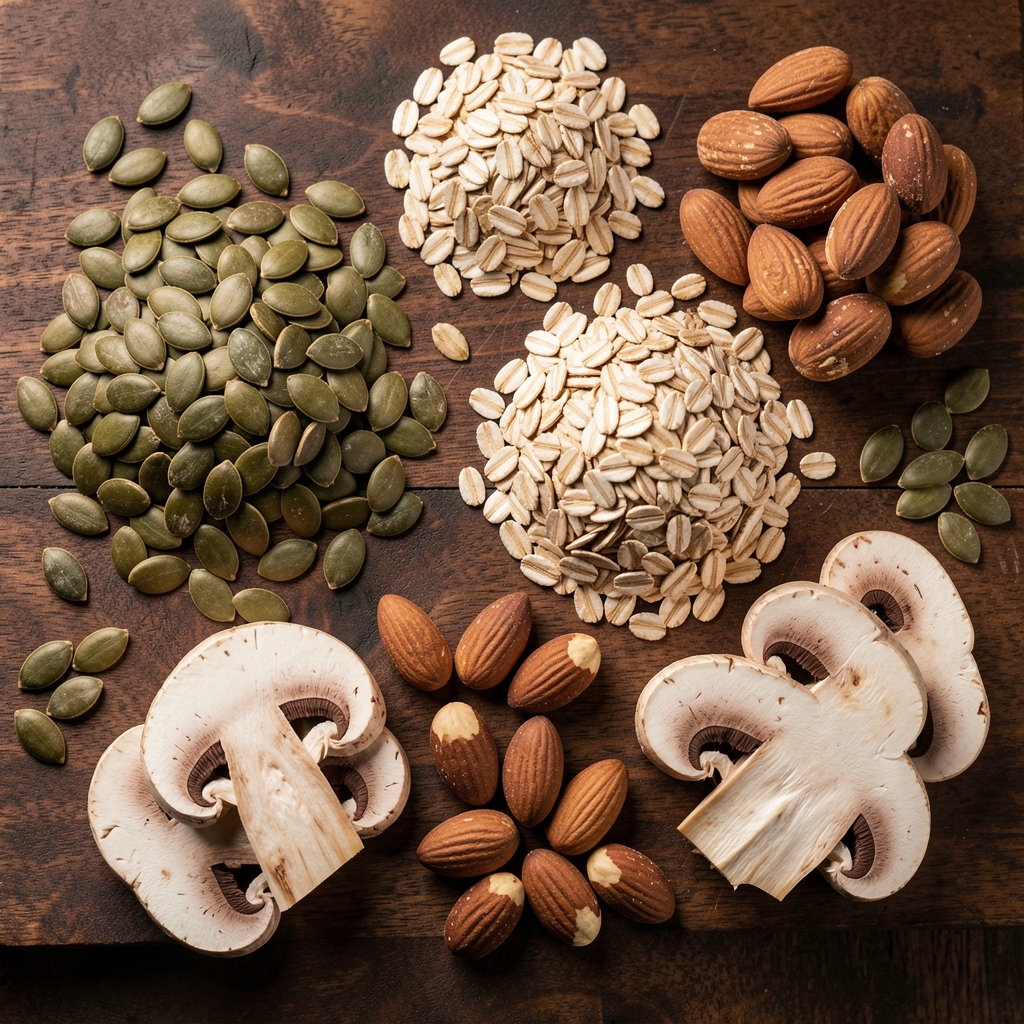
Zinc & Selenium
Trace Minerals in the Weekly Menu: Notes on Zinc-Rich and Selenium-Rich Sources
Eleanor Marsden · 19 February 2026
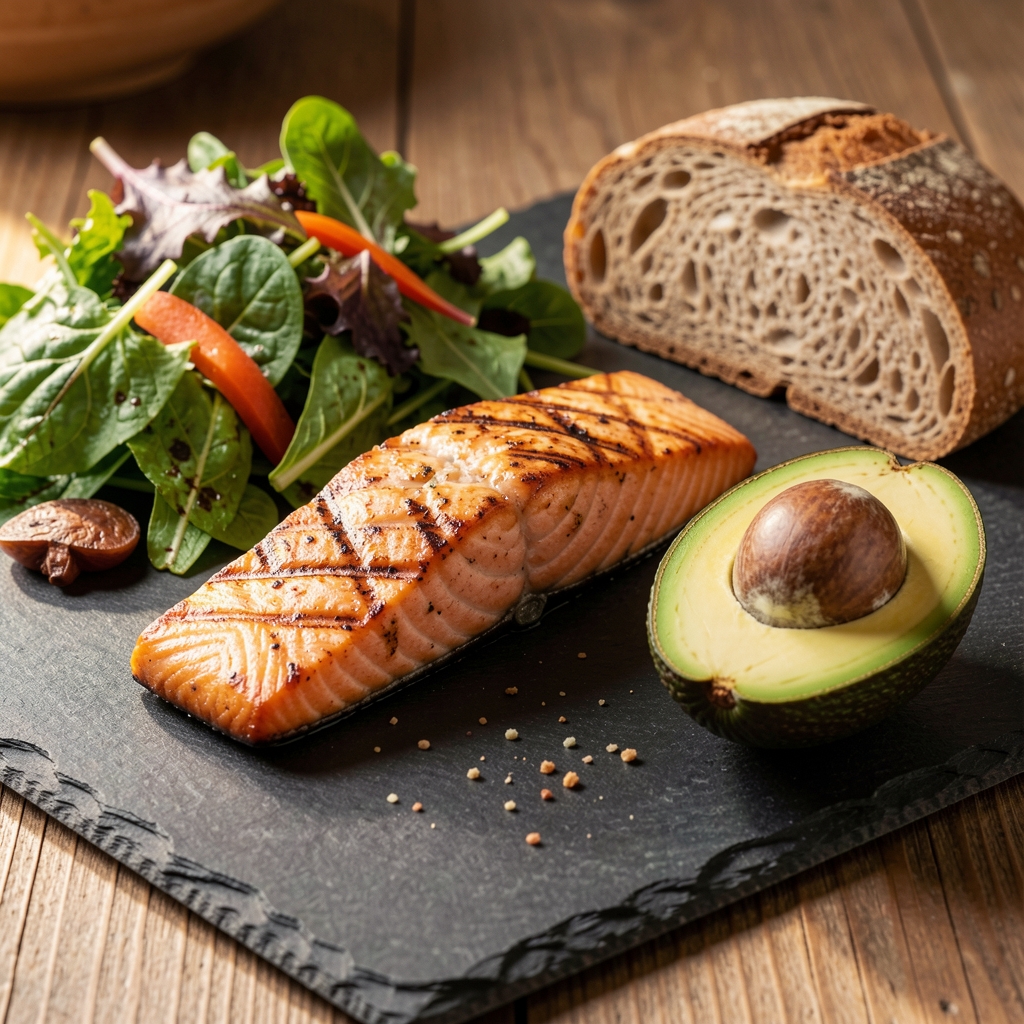
The working week imposes its own nutritional logic. Meetings, commutes, and screen time compress the windows in which food decisions are made, and in that compression a familiar pattern emerges — skipped breakfasts, desk lunches assembled from whatever is nearest, and evenings that compensate for earlier gaps with heavier portions than the body requires. For men navigating this rhythm past thirty-five, the accumulation of these small gaps tends to register not as acute complaint but as a low, persistent friction: diminished focus across the afternoon, slower recovery after exercise, a general flatness that resists easy attribution.
The case for whole grains in the daily diet is not complicated, but it is consistently undervalued in practice. Oats, rye, barley, wholemeal bread, and brown rice contribute dietary fibre, B-vitamins, and a release profile of available energy that differs measurably from refined equivalents. For a desk worker whose caloric expenditure concentrates in mental rather than physical activity, the steady release associated with whole grain carbohydrates provides a functional argument that holds up under the scheduling pressures of the working week.
A balanced breakfast built around oats with added seeds — pumpkin or sunflower — and a protein component such as Greek yoghurt or a soft-boiled egg places the body in a better state for cognitive work before ten o'clock than a breakfast omitted altogether or replaced with a sweetened drink. The midday energy trough, familiar to most desk workers, is not inevitable: it reflects the body's response to a carbohydrate curve that peaked and fell, rather than one that held a more even course through the morning.
Protein-rich meals are the structural anchor of the daily plate for men pursuing an active lifestyle. The recommended intake figures for adult men vary by source and activity level, but the broad consensus within published dietary guidelines situates adequate protein between 0.8 and 1.6 grams per kilogram of body weight per day, with active individuals towards the upper end of that range. Meeting those figures across three meals distributes the nutritional load more effectively than concentrating it in one.
Practical protein sources that require minimal preparation time — tinned fish, eggs, cottage cheese, cooked legumes, lean chicken portions prepared in advance — reduce the friction that causes gaps to appear. The question of post-workout nutrition is also relevant here: consuming a protein component within a reasonable window following physical activity supports normal muscle protein synthesis. A portion of Greek yoghurt, a small tin of sardines on wholegrain toast, or a handful of mixed nuts and a boiled egg are sufficient — there is no requirement for engineered products to meet this function.
“The accumulation of small, documented habits — a breakfast that holds, a midday meal with adequate protein, a post-exercise portion — produces a nutritional pattern that serves the body more consistently than periodic intensive adjustments.”
The role of dietary fat has undergone substantial re-evaluation in published nutritional research over the past two decades. The category of healthy fats — unsaturated fats found in olive oil, avocado, oily fish, and mixed nuts — is now recognised as contributing to a heart-healthy diet rather than undermining one. For men over thirty-five, the inclusion of these fats as regular components of the daily plate rather than occasional additions shifts their contribution from incidental to consistent.
Oily fish — mackerel, salmon, sardines, herring — serves multiple purposes: it is a source of protein, of long-chain omega-3 fatty acids associated with cardiovascular support through food, and of Vitamin D3, a nutrient whose dietary sources are limited and whose adequacy in northern latitudes during winter months requires deliberate attention. Two portions of oily fish per week represents a target used across major UK dietary guidelines. For men who do not consistently reach that figure, the gap between intention and practice is usually one of meal planning rather than preference.
Fibre intake among men in the United Kingdom remains, on average, below the recommended thirty grams per day across the population. The gut-friendly foods most associated with adequate fibre — legumes, oats, root vegetables, brassicas, and fermented foods such as live yoghurt and kefir — are neither expensive nor difficult to prepare, but they require consistent inclusion in the weekly menu rather than incidental presence.
Legumes in particular — lentils, chickpeas, butter beans — are worth noting for their dual role as fibre sources and plant-based protein contributors. A portion of lentil soup or a chickpea-based midday meal contributes to both the fibre target and the protein intake simultaneously, reducing the planning burden on meals later in the day. Fermented foods contribute to gut-microbiome diversity, an area of growing attention in nutritional research, though the editorial position here is that the documentation behind specific claims remains incomplete and readers are advised to follow published dietary guidance rather than extrapolated claims.
For men whose working hours are predominantly sedentary, portion control for men is less about restriction than about calibration. A body expending two thousand kilocalories per day through primarily desk-based activity requires a different plate than one recovering from extended physical training. The practical challenge is that appetites calibrated in more active periods of life do not always adjust automatically when activity levels change.
Using the plate as a visual guide — half vegetables, a quarter whole grains, a quarter protein — provides a structure that functions without counting. It is not a formula that produces precision, but it produces consistent directional accuracy across the week, which is what matters for everyday nutrition habits rather than specialist precision.
Hydration occupies an undervalued position in the nutritional record of most men. The physical signals of mild dehydration — reduced concentration, mild fatigue, slight headache — overlap with the signals of other midday patterns and are therefore frequently attributed elsewhere. A daily hydration target of roughly two litres for sedentary men, rising with physical activity and warm conditions, is consistent across published recommendations. The practical instrument for achieving this is a water bottle at the desk, refilled on a predictable schedule rather than left to thirst as the only prompt.
Electrolyte-rich foods — leafy greens, bananas, avocado — contribute to fluid balance alongside water intake, and are worth including in the weekly menu independent of specific performance goals. The habits that support daily hydration are structural rather than motivational: they are more reliably maintained by environmental design (water visible and accessible) than by periodic effort.
Seasonal eating habits are not merely an aesthetic preference in UK nutritional practice. The seasonal calendar of British produce — spring asparagus and peas, summer courgettes and tomatoes, autumn squash and root vegetables, winter brassicas — aligns reasonably with the nutritional needs and activity patterns that shift across the year. Seasonal produce is typically more nutrient-dense at point of purchase, having travelled shorter distances and been harvested closer to consumption.
The practical argument for incorporating seasonal ingredients into the weekly menu is one of planning: knowing what is likely to be available and at its best each month reduces the friction of food selection and encourages variety across the year. The Dispatch will document seasonal eating notes through 2026 as part of its ongoing field record of everyday men's nutrition.

Tobias Whitfield is the primary editorial correspondent for Doreltan Dispatch, covering practical nutrition for active men, desk-worker eating habits, and the documented relationship between daily food choices and sustained energy. His work is grounded in published dietary research and field observation.
More from Tobias →